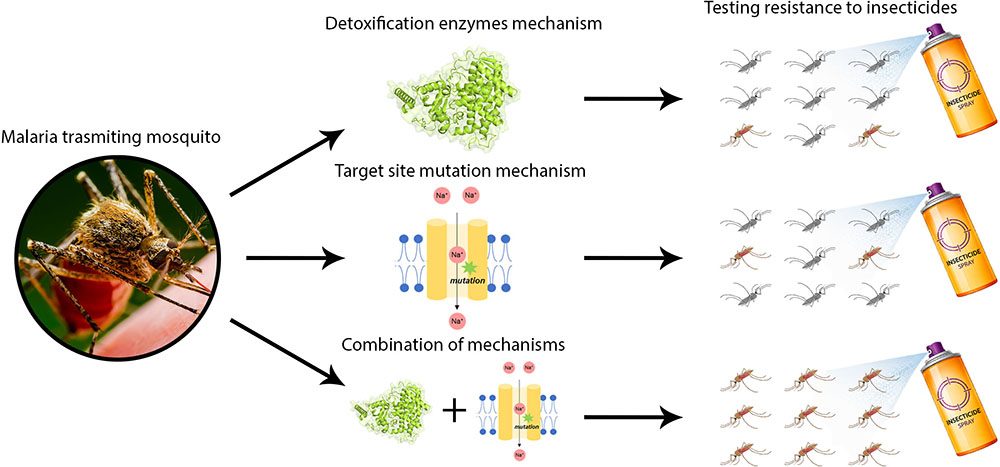
A recent study by the Institute of Molecular Biology and Biotechnology of FORTH reveals the genetic mechanisms that enhance mosquito resistance to insecticides.
Mosquito-borne diseases, including malaria and diseases caused by arboviruses such as dengue and West Nile virus (WNV), pose major public health challenges worldwide. More than 80% of the global population lives in areas at risk of mosquito transmitted diseases, and Europe is no exception, with Greece facing a significant increase in West Nile virus cases this year. Environmental conditions influenced by climate change can further increase the risk of outbreaks by facilitating the spread of invasive mosquito vectors, extending their breeding season, and allowing mosquito populations to persist at high densities.
The prevention and control of mosquito-borne diseases rely heavily on mosquito control. Malaria has halved since 2000, and millions of lives have been saved, largely due to the use of insecticide-based interventions over the last decades. However, their extensive use has led to the selection of insecticide resistance in many mosquito populations, threatening the effectiveness of insecticides.
Researchers from the Molecular Entomology group at the Institute of Molecular Biology and Biotechnology (IMBB) of the Foundation for Research and Technology–Hellas (FORTH) in collaboration with the Liverpool School of Tropical Medicine investigated how mosquitoes can develop extremely high levels of insecticide resistance.
In a study published in the Proceedings of the National Academy of Sciences (PNAS) researchers, with Dr. Linda Grigoraki and PhD candidate Mengling Chen as leading authors, used genetic engineering approaches to investigate the complex molecular basis of insecticide resistance. First, they introduced individual resistance mechanisms, such as mutations in insecticide’s molecular targets and detoxification enzymes, into insecticide-susceptible mosquitoes and measured the effect of each mechanism. When different resistance mechanisms were combined through genetic crosses, resistance levels increased significantly, revealing a striking synergistic effect that also occurs in mosquito populations in the field and can result in substantial loss of insecticide efficacy. Further research is underway to understand the mechanisms underlying this synergistic effect. Leading hypotheses include the possibility that target-site mutations provide more time for detoxification enzymes to act, while different detoxification enzymes may either form complexes with enhanced catalytic activity or function through sequential metabolism leading to more efficient insecticide clearance.
“This is a highly important study that sheds light on the complex genetic basis underlying the very high intensity of insecticide resistance observed in mosquitoes and continues the tradition of the Institute of Molecular Biology and Biotechnology at FORTH in research on insects of medical importance and vector-borne diseases,” emphasizes Prof. John Vontas, Director of IMBB.
FORTH-IMBB has established international collaborations and provides training to scientists from around the world in mosquito control. It is a leading center for research on the characterization of insecticide resistance, as well as the development of molecular diagnostic technologies and effective biopesticides to improve mosquito control, supported by funds from the European Union and the Gates Foundation.
Link to the publication: https://www.pnas.org/doi/10.1073/pnas.2604812123