



September 21, 2022
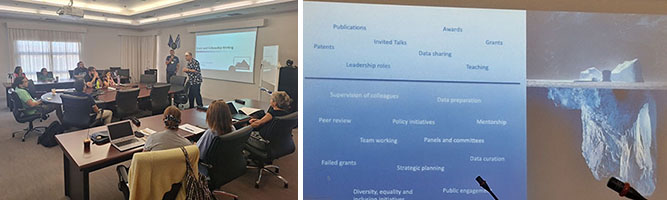
Personal Career plan development workshop as part of the Cyp(non)Tox MSCR programme
__________________________________________________________________________________________________________________
June 17–19, 2024
EMBO Course: Writing successful Fellowship applications
EMBO Scientific Skills Course: Communicating research: paper writing and short presentations
The EMBO courses were organized by Electra Gizeli, Nassi Papoutsi, Tassos Pavlopoulos, Kiki Sidiropoulou and Eva Zacharioudaki with the aid of Rodanthi Lasithiotaki and Christianna Divini.
__________________________________________________________________________________________________________________
April 27 – May 8, 2026
First IMBB Data Analysis Workshop
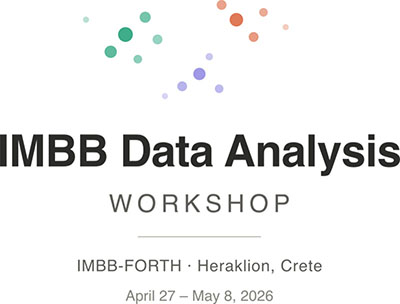
The first IMBB Data Analysis Workshop was held from April 27 – May 8, 2026 at Foundation for Research and Technology - Hellas (FORTH) organized by IMBB Researcher Alexandros Pittis and supported by IMBB’s Mentoring and Career Track Scheme.
Mon 27/4/26 Day 1 Orfanoudakis Room Python Fundamentals - Alexandros Pittis
Tue 28/4/26 Day 2 Orfanoudakis Room Plotting & Data Exploration - Alexandros Pittis
Wed 29/4/26 Day 3 Pagiatakis Room Statistics & P-value Logic - Alexandros Pittis
Thu 30/4/26 Day 4 Pagiatakis Room Enrichment & Dimensionality Reduction - Alexandros Pittis
Mon 4/5/26 Day 5 Pagiatakis Room Bulk RNA-seq analysis - Christos Andronis / Electra Tsaglioti (Bioinformatics Unit)
Tue 5/5/26 Day 6 Pagiatakis Room Single-cell RNA-seq analysis - Vaso Theodorou / Ethan Baird (Delidakis lab)
Wed 6/5/26 Day 7 Pagiatakis Room ATAC-seq - Orsalia Hazapis (Talianidis lab)
Thu 7/5/26 Day 8 Pagiatakis Room Bring your data - Various Instructors
Materials & details: https://github.com/cgenomicslab/imbb-data-analysis
__________________________________________________________________________________________________________________
May 25–29, 2026
EU-LIFE Connects Science
IMBB participated with two researchers in the EU-LIFE Connects Science programme, a new initiative designed to strengthen scientific exchange across the EU-LIFE community. Among six applications submitted by IMBB-FORTH members, PhD candidates Mr. Vaios Theodosiou from Matthieu Lavigne’s group and Mr. Christos Katsioulas from Evgenia Ntini’s group were selected by a three-member committee (John Vontas, Maria Monastirioti and Tassos Pavlopoulos) to take part in this unique opportunity for scientific networking and collaboration across the EU-LIFE network.
Together with researchers from other EU-LIFE Institutes, Vaios and Christos spent one week at the Netherlands Cancer Institute (NKI) in Amsterdam during the EU-LIFE Community Meeting (25–29 May 2026). The EU-LIFE Connects Science programme enabled them to pursue focused scientific activities tailored to their research interests and needs, and would not have been possible without this short, targeted visit. Accommodation in Amsterdam from 25 to 29 May was provided by the NKI, together with access to NKI research facilities and technology platforms, as well as support for experimental costs. Travel expenses were covered by the participating institutes.
_________________________________________________________________________________________________________________
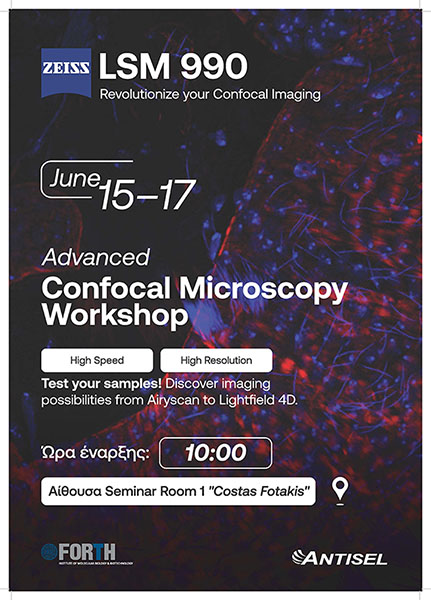
June 15–17, 2026
ZEISS LSM 990 Advanced Confocal Microscopy Demo Workshop
We were pleased to host at IMBB-FORTH an advanced confocal microscopy workshop featuring ZEISS’s newest flagship confocal system, the ZEISS LSM 990. The workshop was co-organized by IMBB’s Mentoring and Career Track Scheme and ANTISEL, the exclusive distributor of ZEISS in Greece.
We are particularly grateful to our colleagues from ZEISS and ANTISEL for bringing their expertise, technical support, and enthusiasm to this event. We also thank the Technical Services Department of FORTH and Marina Ioannou for renovating and preparing the room that hosted the microscope and served as the venue for the demo sessions at IMBB.
The workshop opened on Monday, 15 June, with an introductory presentation of the LSM 990 confocal microscope by ZEISS Applications Specialist Dr. Gerry Sexton. During the three-day event, more than 60 participants from IMBB-FORTH and the Departments of Biology and Medicine at the University of Crete had the opportunity to bring their own samples and, under the guidance of Dr. Sexton and ANTISEL specialists, explore the instrument’s standard and advanced capabilities most relevant to their experimental needs.
_________________________________________________________________________________________________________________
September 23–24, 2026
Training workshops on AI and Grant Writing
As part of the IMBB Mentoring and Career Track Scheme (MCTS), two training workshops led by Dr. David del Álamo and Dr. Thiago Carvalho from Fellowsherpa were held at IMBB, focusing on the responsible use of artificial intelligence (AI) in scientific writing and the non-scientific aspects of competitive grant applications. Both workshops were conducted in person and featured interactive discussions and practical activities.
The first workshop, “Uses and Misuses of AI in Scientific Writing” brought together PhD students and postdoctoral researchers. Through interactive, problem-based activities, participants examined the appropriate use of AI tools in scientific writing and research evaluation, including manuscripts, literature reviews, grant applications, fellowship applications, and peer review. The workshop also addressed emerging guidelines and challenges surrounding the responsible use of AI in research.
The second workshop, “Everything That Is Not Research: Customizing Your Grant Applications” was aimed at senior PhD students, postdoctoral researchers, and junior principal investigators. It explored key non-scientific elements of grant applications, including impact statements, funder priorities, stakeholder engagement, science communication, open science, data sharing, and narrative CVs.
A big thank you to the Fellowsherpa instructors and to all participants for their active engagement.
These workshops are part of the MCTS’s ongoing programme of training and professional development activities, designed to support IMBB researchers at different stages of their careers.
_________________________________________________________________________________________________________________
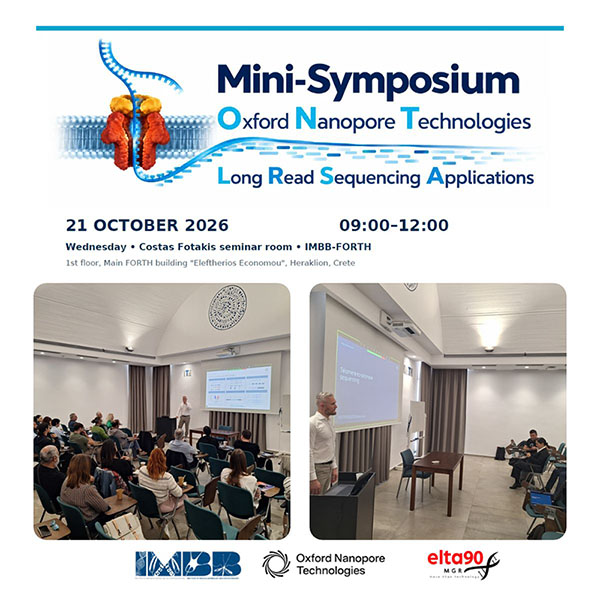
October 21, 2026
Mini-Symposium on Oxford Nanopore Technologies: Long-Read Sequencing Applications
The mini-symposium was co-organized by IMBB’s Mentoring and Career Track Scheme, the IMBB Genomics Facility, and ELTA 90 Group, the exclusive distributor of Oxford Nanopore Technologies (ONT) in Greece. The event highlighted the latest advances and applications of ONT long-read DNA and RNA sequencing in biological and biomedical research. The symposium provided an excellent opportunity to exchange ideas, explore emerging applications, and discuss future research directions and potential collaborations among researchers from IMBB, the University of Crete, and beyond.
A big thank you to ONT application scientists, Dr. Sebastian Ganschow and Dr. Heidi Yoko Jäger, for their insightful presentations and for sharing their expertise on the exciting possibilities offered by nanopore sequencing. Special thanks also go to our IMBB colleagues Dr. Frederic Verret and Dr. Anastasios Pavlopoulos for sharing their research experiences with ONT technology, highlighting its applications in diatom (epi)genomics and in improving the genome assembly and annotation of the crustacean model Parhyale hawaiensis, respectively.
We are grateful to everyone who participated and contributed to the lively discussions, especially to Fotis Lamprou and the ELTA 90 Group for their invaluable collaboration and support in making this event possible. We look forward to continuing these scientific exchanges and exploring new opportunities for research and collaboration in long-read sequencing!